Taming the Storm: A Practical Guide to Emotional Regulation

If you live with ADHD, you probably know what it’s like to get swept up in a wave of emotion.
That storm can be intense — frustration so high you can't finish a project, snapping at someone you love, an impulsive outburst you didn't see coming, tears that surprise you, or those spiraling, self-defeating thoughts you just can't seem to quiet.
ADHD brains process emotions intensely due to a more sensitive and reactive nervous system. But with the right tools, and a practiced PAUSE, you can build the capacity to tame the storm.
Why Emotional Regulation Feels So Hard with ADHD
People with ADHD often feel things more intensely. Our limbic systems are much more sensitive than most neurotypicals. When emotions spike, executive functions—impulse control, flexible thinking, perspective—can drop offline.
Normally, when a threat is detected, the amygdala sounds the alarm, triggering a fast fight-or-flight response while the prefrontal cortex (the brain’s reasoning center) temporarily goes offline. Once the immediate danger passes, the prefrontal cortex quickly re-engages, evaluates the situation, and calms the nervous system so you can think clearly and problem-solve.
In ADHD, the amygdala reacts more intensely, and the prefrontal cortex comes back online more slowly or less effectively, making it harder to shift out of that reactive state. This delay means emotions can feel bigger and last longer, and logical thinking often kicks in only after the body and brain have had more time — or external support — to regulate.
Common emotional patterns include:
Low frustration tolerance: Overwhelm or irritation when things don’t go as planned.
Rejection Sensitive Dysphoria (RSD): Intense pain from perceived criticism, rejection, or failure—even when it’s not really there.
Negative self-talk: Harsh internal messages like “I always mess this up” or “I can’t handle this.”
Disconnect from your prefrontal cortex: You stay in Flight, Fight, or Freeze mode longer.
The Zones of Capacity: Your Emotional Compass
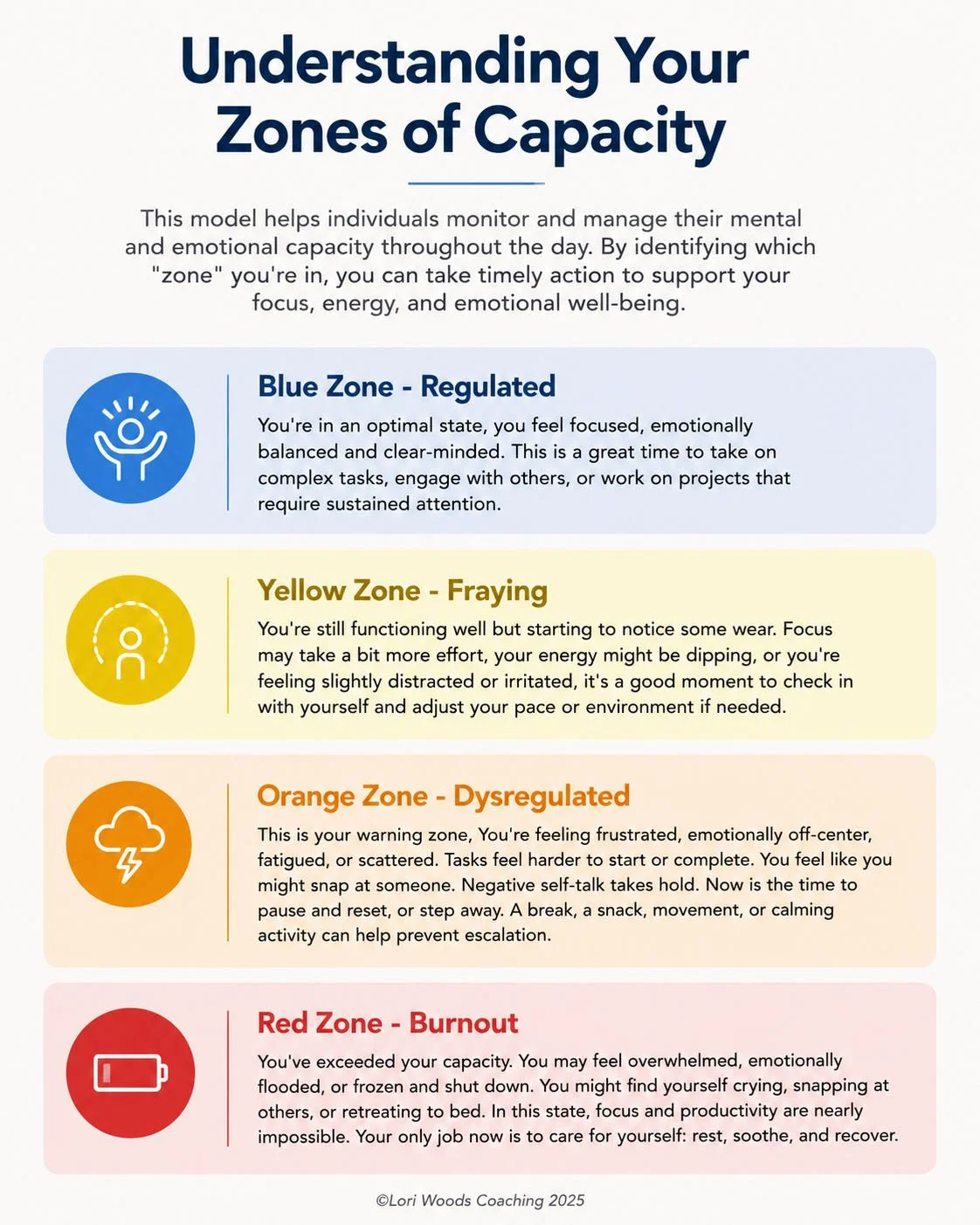
By recognizing your current capacity and responding accordingly, you can build more focus, energy, and emotional regulation over time. We can do this by practicing PAUSING!
The Power of the pause
Pausing gives you a sliver of space between what you feel and how you respond. That’s where emotional regulation lives.
Pause to Become More Self-Aware
What am I feeling right now?
What’s getting in my way?
Where is it in my body?
What might have triggered this?
As we often say: name it to tame it. Naming it gives you a chance to interrupt your story.
Pause to Reframe
Is this thought actually true? What’s the evidence?
Is there another way to look at this that’s more accurate or helpful?
Honest reframes are key. Not fake positivity.
Examples:
“I always screw up.” → “This didn’t go how I hoped, but I can figure it out.”
“They must hate me.” → “I actually don’t know what they’re thinking.”
“This is unbearable.” → “This is hard, but it’s temporary. And I can use my tools and strategies."
Even a small shift can open the door to calmer, clearer thinking.
Emotional Regulation Strategies
1. Externalize the Emotion
Say your feelings out loud.
Write them down.
Talk them out with a coach, therapist, friend, or trusted family member.
Getting them out of your head makes them less overwhelming.
2. Body-Based Regulation
Breathe in through your nose deeply and exhale through pursed lips as if blowing out a candle but slower.
Use the 5-4-3-2-1 grounding technique:
5 things you can see: Look around and notice 5 details in your environment.4 things you can feel: Notice physical sensations, such as the texture of your clothing, the chair supporting your back, or your feet against the floor.
3 things you can hear: Focus on sounds in your environment that you might otherwise tune out, like distant traffic, a ticking clock, or a fan blowing.
2 things you can smell: Pay attention to the scents around you, such as freshly brewed coffee, your lotion, or the air in the room.
1 thing you can taste:
Move your body.
Try cold water on your hands or face.
Place an ice pack on the back of your neck or forehead.
Your body can regulate faster than your mind can “logic” its way out.
3. Transition Rituals
Give yourself buffer time between activities. A five-minute reset—a stretch, short walk, or music—can help prepare your brain for the next step.
4. Name the Need Beneath the Feeling
Strong feelings often point to unmet needs: rest, clarity, safety, support, or connection. Allow yourself to meet the need of the moment, even if just for a short time.
5. Build Your Capacity
Small breaks throughout the day keep you in green or yellow. Don’t wait for orange or red.
Take some time off.
Do fun things.
Do hard things in small bites and celebrate wins afterward.
6. Parts Language
Instead of “I’m a failure,” try:
“A part of me feels like a failure right now.”
This creates space between you and the feeling.
7. Future Self Coaching
Ask: “What would I tell myself 24 hours from now?”
Future you often has a better perspective.
8. Don’t Escalate the Spiral
If you’re in red, don’t fix everything at once.
No arguing. No big decisions. No problem-solving.
Regulate first. Respond later.
Common Triggers and How to Catch Them Early
Recognizing triggers early is often the difference between orange and red.
Common triggers for ADHD emotional storms:
Sensory overload (noise, light, crowds)
Transitions or interruptions
Feeling criticized or rejected
Unmet expectations—especially your own
Fatigue or lack of sleep
Feeling out of control or disorganized
Catching the shift early gives you space to regulate before the storm takes over.
Putting It All Together
Picture this. You’re at work. Someone gives unexpected feedback on something you poured your heart into.
RSD flares. Your chest tightens. Thoughts spiral: “They hate it. I’m a failure.” You’re in orange.
You catch it. “This is my RSD.” You pause. You name the feeling—hurt, shame, panic. You remind yourself: “I don’t actually know what they’re thinking. This might be uncomfortable, but it’s not catastrophic.”
You step outside. Walk. Breathe. Text a friend. The storm eases. You return to blue or yellow. Now you can respond instead of react.
Emotional regulation isn’t about perfection. It’s about training your system to be less reactive and to learn to return to your baseline more quickly.
You Don’t Have to Do It Alone
Learning emotional regulation is a practice, not a performance. Many of us were never taught these skills, but we can build them now.
Coaching, therapy, communities, and trusted friends make a difference. Medication, sleep, nutrition, exercise, and daily structure help too.
For more ways to calm your nervous system, especially for those with ADHD or anxiety, read my blog on how to recharge the ADHD brain.